A small apartment changes what a Bluetooth speaker has to do. You are not filling a park, you are filling a room of nine to fourteen square metres with a shared wall on at least one side, and the two things that matter most in that room are not the ones the spec sheets lead with. Below are three speakers that all cost under $100, what each is actually good at, and what the ratings behind them do and do not tell you.
What matters in an apartment, in order
One: how it handles bass at low volume. In a 300-square-foot flat you will listen at 40 to 60 percent, not at party level. Two speakers at the same list wattage can sound completely different there, because at low volume a small driver stops moving air and the bass disappears. That is why the models with passive radiators hold up in a living room and the ones without sound thin until you turn them up, at which point the neighbour hears the bass and you hear nothing new.
Two: whether the bass leaks through the wall. Low frequency is the least directional and the most penetrating. A closed door stops the treble and lets the thump through. Nothing in this price range solves it; the only levers you control are placement (away from the shared wall, off the floor, not on a hollow shelf) and volume. If you can hear the bass in the next room, so can they.
Three: how it behaves as a single object. A speaker you have to move to charge, or that needs a cable, ends up in a drawer. Battery life and a strap matter more than a frequency response chart nobody can verify.
| soundcore 3 | Sony SRS-XB100 | OontZ Angle 3 | |
|---|---|---|---|
| Published power | 16 W stereo | Not stated as wattage | 12 W |
| Drivers | Dual, titanium diaphragms to 40 kHz | Single full-range, diffusion processor | Dual + downward passive radiator |
| Bass trick | Dual passive radiators, BassUp | Diffusion processing, not bass boost | Passive radiator |
| Playtime (published) | Up to 24 h | Up to 16 h | Not the headline claim |
| Water | IPX7 | IP67 | IPX5, splash only, not submersible |
| Amazon base | 4.5 stars on 15.7K | 4.4 stars on 6.5K | 4.5 stars on 164.4K |
| Price | $49.99 | $63.00 | $24.99 |
Everything in that table is the manufacturer’s published claim. I have not measured any of it, and neither has anyone else writing a spec comparison — treat the playtime numbers as the ceiling, because they are measured at moderate volume with the bass enhancement on.
1. soundcore 3: the one that keeps its bass when you turn it down
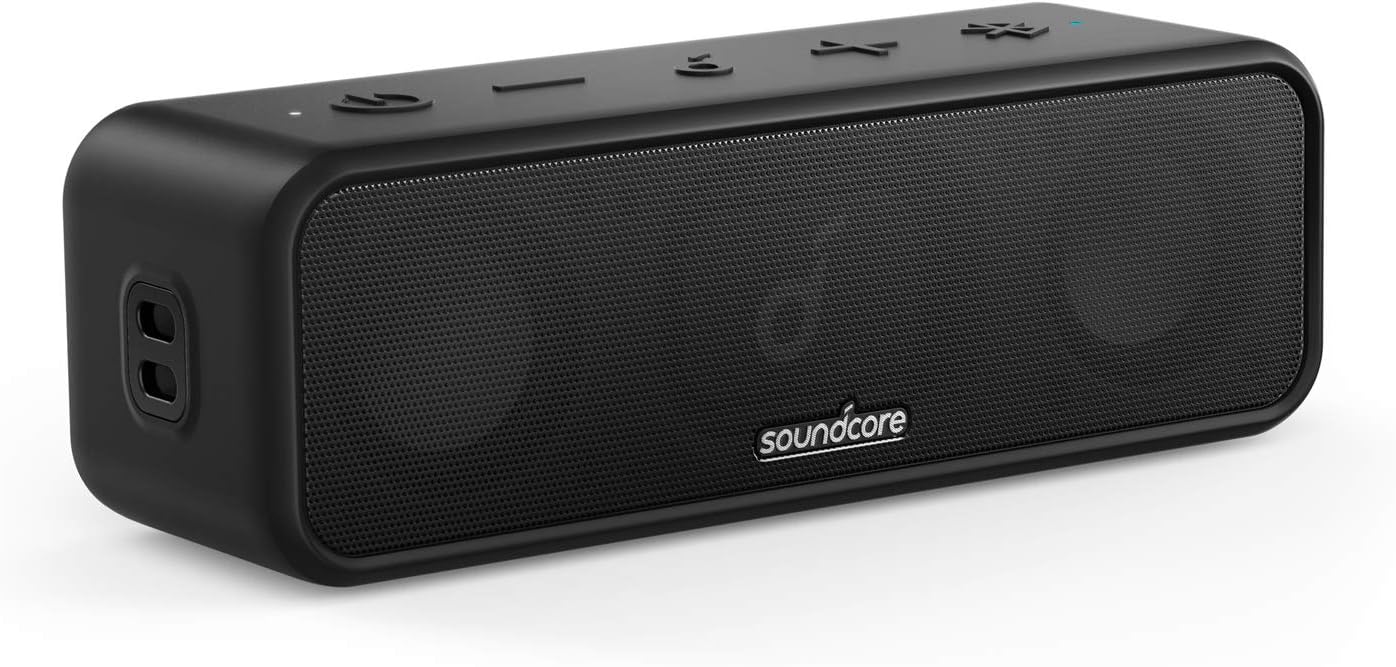
The reason this one is first is not the 16 watts. It is the pair of passive radiators and the BassUp processing, which exist for exactly the situation an apartment creates: quiet listening where a driver alone cannot move enough air to make bass audible. Anker also built the treble end deliberately, with titanium diaphragms quoted up to 40 kHz, which is marketing for a band almost nobody can hear; the useful part is that the top end does not turn harsh when you raise the volume.
Twenty-four hours of published playtime means you charge it roughly once a week rather than once a day, and IPX7 means it survives the shower and the sink, which is more relevant in a flat than on a beach. At $49.99 it sits in the middle of the three.
Buy it if you listen at moderate volume in one room and want the low end to still be there. Skip it if you want a speaker that fills a whole flat at once; 16 watts of stereo in a small box will not do a 700-square-foot open plan.
Check current price on Amazon →Paid link · we earn a commission if you buy, your price does not change
2. Sony SRS-XB100: the one that survives being carried around

Sony’s small speaker is IP67 rather than IPX7: the extra digit means dust-tight as well, which matters if it lives in a bag or on a windowsill. It is the only one of the three rated for dust, and it is also the only one whose published approach to room-filling is a diffusion processor rather than more bass — it spreads sound outward instead of pushing it at you, which suits a room where you move around while it plays.
Sixteen hours is the shortest playtime of the three, and the price is the highest. What you are paying for is the strap, the 360-gram-ish portability and the build, plus stereo pairing if you later buy a second one. That pairing is the upgrade path the other two do not offer as cleanly.
Buy it if the speaker travels with you and gets knocked about. Skip it if it will sit on one shelf for three years; then the cheaper soundcore does more of what an apartment needs.
Check current price on Amazon →Paid link · we earn a commission if you buy, your price does not change
3. OontZ Angle 3: the one with 164,000 ratings

The number that stopped me is the review base: 164,400 ratings at 4.5 stars. That is not a small-product signal, that is the most-sold cheap speaker on the platform, and it deserves a paragraph of its own because it teaches something the spec sheets cannot.
Twelve watts, dual drivers, a downward-facing passive radiator, a claimed 100-foot Bluetooth range and IPX5 — splash and light rain, not submersible. At $24.99 it is a quarter of the Sony. It is also the oldest design of the three, with a plastic shell that will not feel like the other two in the hand.
What 164,000 ratings mean in practice: the failure modes are already public. Buyers report the same small set of issues across years of listings, which is a more useful kind of information than any single review. A brand-new speaker with 12 ratings has a 4.4 average that could still move; this one’s 4.5 has been stress-tested by a mass market.
Buy it if you want a speaker for the kitchen counter, the bathroom shelf, or as a second unit, and you would rather spend the difference on something else. Skip it if you care about how it sounds at low volume with bass-heavy music — this is the one that thins out first.
Check current price on Amazon →Paid link · we earn a commission if you buy, your price does not change
The short version
Under $50, buy the soundcore 3 and accept its size. Around $60, buy the Sony if the speaker leaves the house. Under $30, the OontZ is the safest cheap purchase on the platform by review volume, as long as you accept IPX5 and an older design. None of the three will fill a large open-plan flat, and none of them will stop bass reaching the other side of a wall — those are limits of physics and price, not of brand choice.